
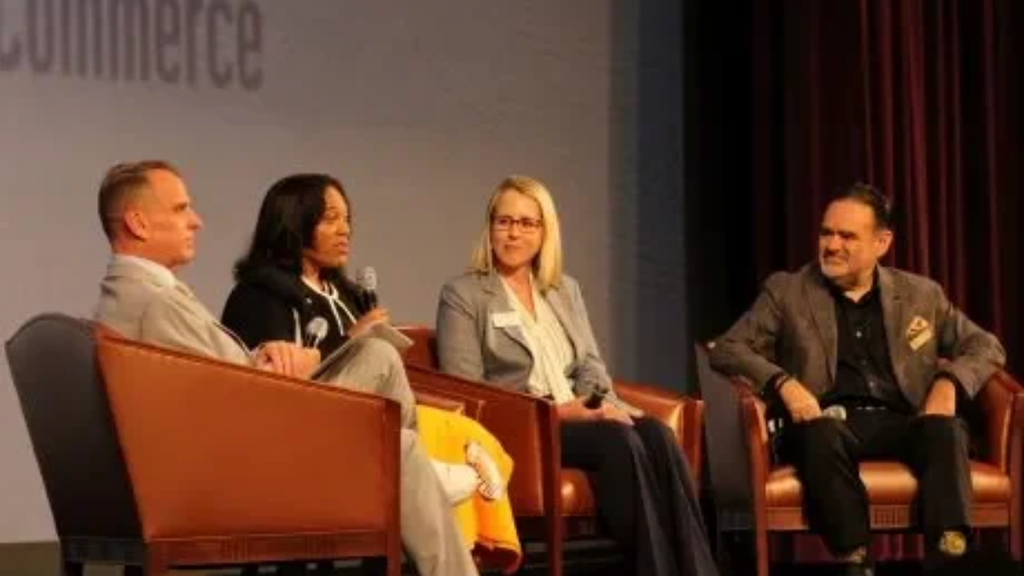
How do you prepare students for jobs that keep changing, and then convince them to stay and build careers close to home? The heads of four of Tyler’s biggest schools took on that question Thursday at the Tyler Area Chamber of Commerce’s State of Education luncheon.
The panel included Tyler ISD Superintendent Dr. Marty Crawford, Texas College President Dr. SherRhonda Gibbs, University of Texas at Tyler President Dr. Julie Philley, and Tyler Junior College President and CEO Dr. Juan Mejia. They talked about school-college partnerships, local workforce needs, artificial intelligence in the classroom, and why students need to learn money skills and civic responsibility.
Texas College Builds Skills Beyond the Classroom
Texas College was founded in Tyler in 1894. It is now trying to connect what students learn more closely to the jobs waiting for them after graduation, and its main tool for that is the THRIVE initiative.
Gibbs said THRIVE is meant to give students skills they wouldn’t usually get from a regular class schedule. One example is a Civics 101-style course the college is planning with the Chamber of Commerce and the city. In it, city leaders will explain how planning and zoning shape a neighborhood, which taxes residents pay, and where that money goes.
Gibbs said the college wants to become a nationally known applied liberal arts school that leads students straight into graduate programs or jobs. She described the goal as graduates who are ethical, emotionally intelligent, faith-informed leaders who are “prepared for the workforce on day one.”
The college also plans to work with an outside company to teach financial literacy, building on the money lessons students get before college.
TJC Celebrates 100 Years and Keeps Talent Local
Tyler Junior College is celebrating its 100th anniversary this year. Mejia said TJC serves about 23,000 individual students a year. This semester, credit enrollment passed 13,000 for the first time, and the college offers more than 140 degree and certificate programs.
More students are now choosing workforce credentials and job-focused programs instead of the traditional route of transferring to a four-year university.
Mejia is proud that about 75% of TJC graduates stay in the Tyler area. He said the region’s future depends on recruiting and keeping talented people, and on bringing strong companies to East Texas so the local economy keeps growing.
UT Tyler Expands Health Care and Teacher Training
Philley said UT Tyler is growing the programs East Texas needs most, especially in health care and education.
The university’s School of Medicine welcomed its fourth class this summer, and its first class should graduate in May 2027. The school has already created more than 22 residency and fellowship programs in areas such as surgery, oncology, and cardiology to help train more doctors for the region.
Next fall, UT Tyler plans to open a physician assistant program in Longview. It is also continuing to strengthen nursing and other health programs.
Teacher training is a big focus too. Philley introduced Dr. Robert DeHaas, the new dean of the College of Education. She said that although her own background is in health, she is very focused on producing certified teachers for school districts in Regions 7 and 8 in East Texas, and that the right leadership is essential to doing it.
Tyler ISD Grows Its Own Teachers
Crawford said Tyler ISD is building its own pipeline of future teachers while also getting students ready for college and careers.
The district’s Grow Your Own program encourages students, especially Early College High School graduates, to think about becoming teachers. Through partnerships with local colleges, some of them could come back to teach in the district and help fill ongoing staffing gaps.
Crawford said the district wants to keep its standards high. He also wants every teacher to have a strong curriculum and high-quality teaching materials, which matters even more for teachers who come up through the district’s own pipeline.
Teaching Money Skills and Giving Back
The panel agreed that preparing students means more than academics and job training. Students also need to know how to manage money and how to take part in their communities.
Crawford said personal finance is becoming a required course in Texas schools, and he called it an important addition to K-12 education.
Mejia talked about TJC’s Promise program and made one point very clear: it was never just “free college.” Foundation supporters had to raise $25 million to build the endowment that pays for it.
Students in the program must commit to volunteer work with a nonprofit, and each school district decides how that service gets done. Mejia said the goal is to teach students to give back, so they see the scholarship as something they earned and not just a gift.
TJC Regroups After Voters Reject Bond
During the audience question-and-answer session, someone asked Mejia about the TJC bond package voters turned down earlier this year and what the college will do about its buildings now.
Mejia said the facility needs haven’t gone away, and college leaders are working out a new plan. TJC has a backup option, but it doesn’t cover as much as the original bond. The college may have to close or scale back some programs to pay for its top priorities, and it will also ask the state Legislature for help.
He said TJC respects the voters’ decision and thanked the people who supported the bond. The priorities haven’t changed, he said, but the college heard the community and will find another way to meet them.
Crawford encouraged attendees to tour TJC’s Pirtle Technology Building to see the needs for themselves. He said it has hardly changed since many of them walked through it in the 1960s and ’70s. He added that passing a bond is never easy, because the economy and the national, state, and local political mood all affect the timing. Tyler ISD’s own facilities took several tries and many years to win approval.
AI Is Changing Education, but the Basics Still Matter
Another audience question asked how AI is changing education and how schools are preparing students for an AI-driven workforce.
Philley joked that she now gets beautifully written emails from people who can barely put a sentence together. Her point was that being able to produce polished work with AI doesn’t mean someone will succeed in real life.
That’s why UT Tyler is putting extra emphasis on basic skills and human qualities like kindness, empathy, and the ability to disagree respectfully. Philley said those things don’t come automatically. They have to be taught.
Gibbs agreed. She said students need strong reading, writing, and research skills so they can judge what AI and online sources tell them. Critical thinking, built through general education and liberal arts classes, helps students tell truth from fiction.
Crawford pointed to a practical upside for teachers. He said carefully vetted AI tools could help them find quality materials and spend less time building lessons, especially teachers who enter the profession through alternative routes. That could mean fewer late nights working past midnight and more energy for teaching students.
Tyler ISD Shows Academic Gains
During his presentation, Crawford shared recent progress at Tyler ISD. The district earned an accountability score of 83 and now has more A- and B-rated campuses than ever under the state’s current rating system.
He named several high-performing campuses, including Jones and Bonner elementary schools, Moore Middle School, Early College High School, RISE Academy, Tyler High School, and Legacy High School. He also mentioned Caldwell Elementary Arts Academy and said strong results are possible in every part of the district.
A $2 Million Push at Boulter Middle School
Crawford also described the district’s plan for Boulter Middle School under the Accelerated Campus of Excellence (ACE) model, which gives extra resources and support to campuses that need it.
The district redesigned its approach using state resources and programs because, Crawford said, every Tyler ISD student deserves an A- or B-rated middle school. He said Boulter is on its way.
Tyler ISD has committed about $2 million in extra resources to the campus. The school board approved the plan unanimously after trustees visited similar programs in Houston and Shreveport, Louisiana.
Crawford said the district is putting resources where they’re needed most and being creative about it. He tied the effort to recruiting and keeping good teachers, and said the district will keep building teacher pipelines and partnerships.
A Call to Change School Funding
Crawford also called on state lawmakers to change how Texas funds public schools. Instead of paying districts based on average daily attendance, he wants funding based on student enrollment. He said that switch could bring Tyler ISD 5% to 8% more funding without raising local taxes.
He closed with the district’s core belief: student success comes from quality teaching, not from a ZIP code. He said Tyler ISD will keep strengthening the teaching profession through pipelines, partnerships, and new initiatives.