
If you’ve seen headlines saying California has a “new rule” on right turns at red lights, you’re probably wondering whether you can still turn right on red in your daily commute.
The short answer is yes, in most places. The longer answer is that some things really are changing around red lights in California, and some of them could cost you money if you aren’t paying attention.
Here’s what’s actually true, what’s changed, and what every driver should keep in mind.
First, the Basics: Right on Red Is Still Legal Statewide
Let’s clear this up first. There’s been no statewide ban. Under California Vehicle Code Section 21453, except when a sign prohibits the turn, a driver who has stopped at a steady circular red signal may turn right, or turn left from a one-way street onto a one-way street.
Even the DMV-focused guides for 2026 describe it the same way: right-turn-on-red is permitted after a full stop unless posted otherwise. Independent legal trackers agree too, noting that some cities have discussed restricting right turns on red for pedestrian safety, but no statewide changes have been made.
So if you’ve been turning right on red at your neighborhood intersection, you haven’t been breaking a new law.
The Rules You Still Have to Follow Every Time
The privilege comes with strings attached, and many drivers get these wrong.
- Come to a full stop. A rolling “California stop” doesn’t count. You must stop before reaching the nearest of a marked limit line, a crosswalk, or the intersection.
- Yield to everyone. A driver making the turn must yield to pedestrians lawfully in an adjacent crosswalk and to any vehicle approaching closely enough to be an immediate hazard.
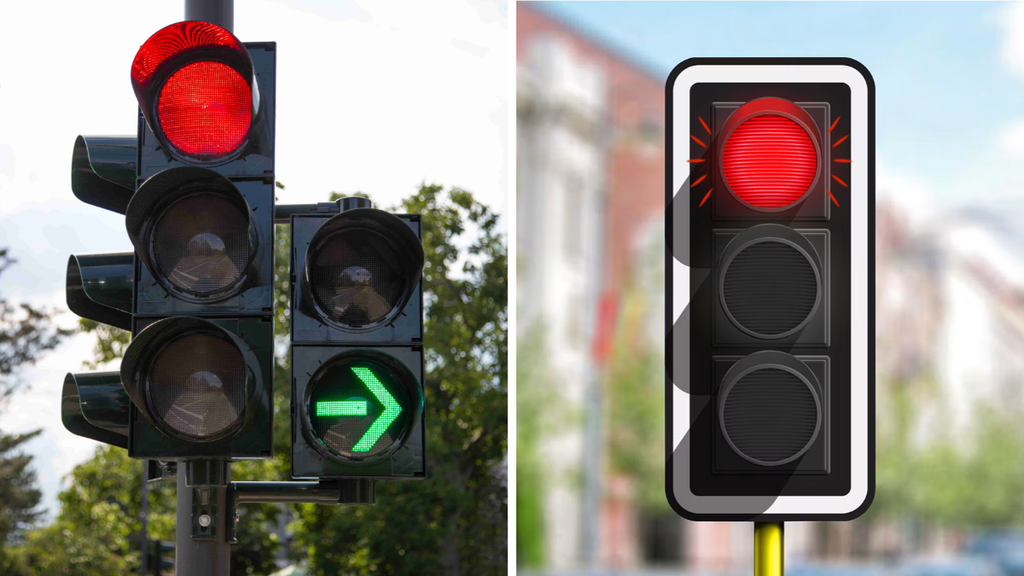
- Red arrow means no. This is the big one. CVC 21453(c) says you cannot turn right at a steady red arrow signal. A red circle and a red arrow are not the same thing.
- Obey the signs. A “NO TURN ON RED” sign overrides the general rule, every single time.
The Real Change: Red Light Cameras Are Getting an Upgrade
This is likely what set off the “new rule” headlines. On October 13, Governor Newsom signed Senate Bill 720, authored by Senator Ashby, which creates an alternative approach for how cities can run red light camera programs. The DMV lists SB 720 (Ashby), Automated Traffic Enforcement System Programs among the new laws that took effect on January 1, 2026.
Here’s why it matters for right turns. A state Assembly committee analysis of the bill notes that participating jurisdictions handle notices of violations, including a violation for a prohibited right turn. In plain terms, if you turn right on red where a sign forbids it, a camera in a participating city could catch it.
The new system works differently from the old one. For cities that opt in, fines for first-time violations are capped at $100, and the ticket goes to the vehicle rather than the driver, making it a civil offense. Instead of a photo of your face, the license plate is captured, and the violation goes to the registered vehicle owner.
It’s also worth knowing that this is opt-in. The new law doesn’t replace existing red light camera legislation, but offers an alternative for cities that choose it. Supporters say the old setup was outdated, since California hadn’t updated its red light camera regulations in 30 years.
San Francisco Is Where Right on Red Is Really Disappearing
If you drive in San Francisco, the change is real and visible. The San Francisco Municipal Transportation Agency expanded its “No Turn on Red” program to 200 intersections in Union Square, Chinatown, North Beach, South of Market, and the Financial District.
The city has gone further on paper, too. The Board of Supervisors voted unanimously to support a citywide ban on turning right on red, although that resolution had not been signed by the mayor or implemented. City engineers have pushed back on a blanket rule.
City Engineer Ricardo Olea said a citywide ban wouldn’t serve every intersection well, particularly quieter ones with little pedestrian and vehicle traffic.
The bottom line for San Francisco drivers: look up before you turn. The sign is what counts.
Why Cities Are Rethinking Right on Red
The debate comes down to pedestrian safety. According to the SFMTA, turn-on-red crashes accounted for 20% of pedestrian- or bicycle-related injury crashes involving drivers turning at signalized intersections.
San Francisco isn’t alone. Other major cities such as Los Angeles, Seattle, and Denver have looked into bans as well, and Seattle made it the default policy to prohibit right on red when new traffic signals are added.
There’s another side, though. Critics point to data suggesting the risk is smaller than it sounds. A National Motorists Association study of California found that even when crashes were linked to right turns on red, at least 96% of injuries to pedestrians or cyclists were minor.
Even SFMTA figures show that only about 2.5% of citywide pedestrian injury crashes came from a driver turning right on red.
What Does an Illegal Right Turn on Red Cost?
Under the traditional ticket system, base fines are $100 for running a red light and $35 for an illegal turn at a red light. Don’t let that $35 fool you. Court fees and penalty assessments in California usually push the total well above the base fine. Points matter too: running a red light or making an illegal turn adds one point to your DMV record.
And whatever you do, don’t ignore the ticket. Ignoring a Vehicle Code 21453 ticket will likely lead to a failure-to-appear charge, which can be filed as a misdemeanor.
One More Intersection Rule Drivers Keep Missing
While you’re thinking about intersections, remember California’s daylighting law. Starting March 1, authorities began issuing fines for violations of the daylighting law, and San Francisco has used red-painted curbs to mark no-parking zones near crosswalks.
The idea is simple: keep the space near crosswalks clear so drivers turning at the corner can actually see people stepping off the curb.
Sources :
- https://california.public.law/codes/ca_veh_code_section_21453
- https://apcp.assembly.ca.gov/media/1003